 en
en  русский
 한국어
한국어 get a free quote

Why Zipper Dimensions Are an Engineering Decision, Not a Guess
A zipper that looks right is not necessarily a zipper that performs right. Chain teeth separating under load, sliders jamming mid-stroke, fabric tape puckering at the seam — these failures almost always trace back to a dimension mismatch that could have been caught at the specification stage. Yet in practice, many purchasing decisions still come down to a single number stamped on the back of a slider, with no reference to tape width, chain thickness, or length tolerance.
There are three distinct dimensions that define any zipper: gauge (the width of the closed teeth), tape width (the fabric carrier on either side of the chain), and length (the active closure distance). Each one affects a different aspect of how the zipper integrates into a product and performs over time. Specifying all three — not just the gauge — is what separates a professional procurement process from an informed guess.
This guide breaks down each dimension, explains how to measure it accurately, and provides the application context needed to translate those numbers into the right specification for your product.
Content
- 1 Zipper Gauge: The Number That Controls Strength and Compatibility
- 2 Tape Width and Chain Thickness: The Two Dimensions Most Buyers Overlook
- 3 Zipper Length: How It's Measured and Why Tolerances Matter
- 4 How Gauge Dimensions Vary Across Nylon, Delrin, and Metal Chains
- 5 Matching Dimensions to Application: A Practical Specification Guide
Zipper Gauge: The Number That Controls Strength and Compatibility
Gauge is the most visible dimension and the most commonly cited, but it is also the most widely misunderstood. The gauge number — #3, #5, #8, #10 — represents the approximate width of the closed zipper teeth in millimetres. A #5 zipper has teeth that measure approximately 5 mm across when fully closed. The number is not a size code in an arbitrary catalogue; it is a direct measurement reference.
The correct way to measure gauge is with a digital calliper placed across the teeth of a fully closed zipper. The measurement should be taken at the widest point of the interlocked teeth, excluding the fabric tape entirely. Some sliders carry the gauge number embossed on their reverse face, but this can reflect the mould reference rather than the actual tooth width — when precision matters, always measure directly rather than relying solely on the stamped number.
| Gauge | Approx. Teeth Width | Typical Applications |
|---|---|---|
| #2 | ~2 mm | Lightweight garments, small pouches, cosmetic bags |
| #3 | ~3 mm | Dresses, skirts, cushion covers, fine accessories |
| #4.5 | ~4.5 mm | Handbags, medium-weight garments, pillow covers |
| #5 | ~5 mm | Jackets, backpacks, upholstery, duffel bags |
| #7 | ~7 mm | Tents, heavy bags, outdoor covers |
| #8 | ~7.2–8.0 mm | Outdoor gear, marine canvas, wetsuits |
| #10 | ~10 mm | Sleeping bags, industrial enclosures, boat covers |
| #12–#15 | ~12–15 mm | Large tents, portable shelters, heavy marine canvas |
Gauge controls more than aesthetics. A higher gauge number means wider, heavier teeth with greater cross-sectional mass — which translates directly into higher tensile strength, greater resistance to lateral spreading, and a larger slider profile. The slider and chain must be matched to the same gauge: a #5 slider will not engage a #8 chain, and attempting to force the fit damages both components. Nylon zipper sliders matched to chain gauge ensure the clearance tolerances inside the slider body are correctly sized for smooth, reliable engagement across the full length of the closure.
As a general rule: match gauge to fabric weight and product load. Lightweight fabrics (silk, chiffon, lightweight polyester) pair with #2–#3. Medium-weight fabrics (cotton, standard polyester, canvas) suit #4.5–#5. Heavy-duty applications involving canvas, leather, coated nylon, or structural load call for #8 and above.
Tape Width and Chain Thickness: The Two Dimensions Most Buyers Overlook
Gauge gets all the attention, but tape width and chain thickness are equally consequential for professional-grade product development — and they are almost never specified by buyers who rely solely on the gauge number.
Tape Width
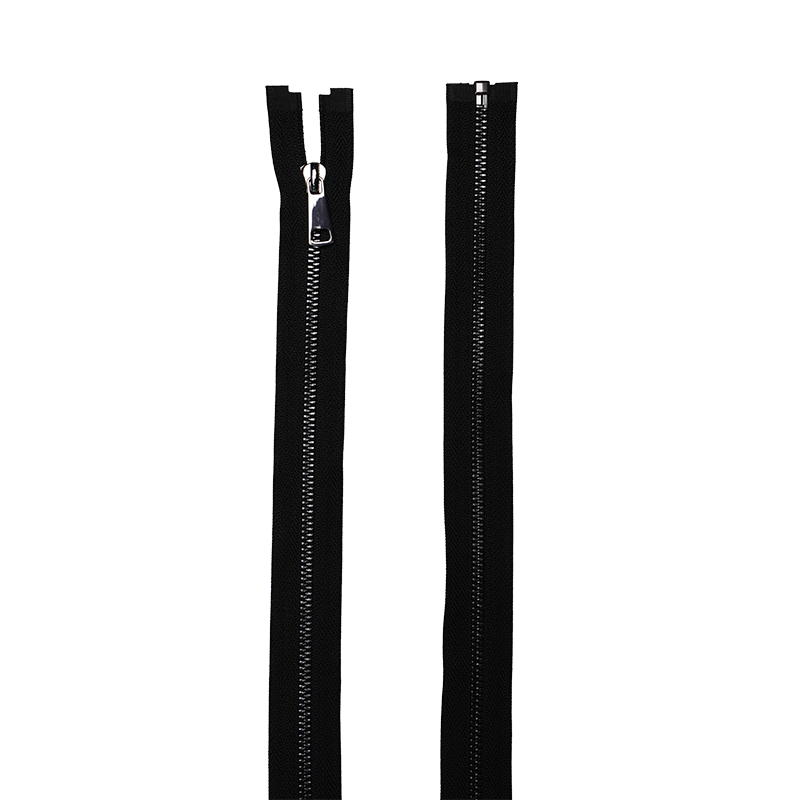
The zipper tape is the woven fabric strip on either side of the chain. Tape width determines how much sewing margin is available when the zipper is sewn into a seam, and it directly affects whether the stitching line clears the teeth or risks catching them. A tape that is too narrow for the seam allowance in a pattern will force the needle dangerously close to the chain. A tape that is too wide will create unnecessary bulk at the seam, particularly in tailored garments or precision luggage.
Tape width is measured from the outer edge of the tape to the centreline of the teeth. Standard tape widths range from approximately 12 mm on fine #2–#3 zippers to 30 mm or more on heavy industrial gauges. For garment applications, most pattern instructions assume a specific tape width — specifying a different width without adjusting the seam allowance is a common and avoidable source of fit problems.
For a detailed breakdown of how zipper chains differ in thickness and strength across applications, the relationship between these physical parameters and end-use performance is explored in full.
Chain Thickness
Chain thickness — the depth of the interlocked teeth measured perpendicular to the tape plane — matters most in layered or laminated product constructions. In a quilted jacket, a mattress cover, or a technical outdoor shell, the zipper assembly may sit beneath or between additional fabric layers. A chain that is too thick for the surrounding construction creates pressure points, restricts slider travel, and can deform the face fabric at the closure line.
Chain thickness is not consistently published in commercial catalogues, but it is a parameter covered under ASTM D3657, the Standard Specification for Zipper Dimensions, which defines standard values for zipper length, tape width, and associated tolerances across all materials and size designations. Specifying to ASTM D3657 gives buyers a documented reference point for supplier verification and quality control purposes — particularly important for large-volume procurement where dimensional consistency across production runs is critical.
Zipper Length: How It's Measured and Why Tolerances Matter
Zipper length is measured from the top stop (the metal or plastic component that prevents the slider from leaving the chain at the top) to the bottom stop (the equivalent component at the lower end). This is the active closure length — the distance over which the slider actually travels. It does not include the tape end extensions beyond the stops, which are present to allow for sewing attachment but are not part of the rated closure length.
For finished zippers, the stated length should match the opening length in the product pattern exactly. A zipper specified as 20 cm should close 20 cm of opening — not 18 cm with tape hanging loose at the bottom, and not 22 cm requiring the stop to be repositioned. Finished nylon zippers cut to specified lengths are manufactured with the stop positions set to deliver a precise active length, eliminating the repositioning step required when working from chain by the roll.
Length Tolerances in Bulk Orders
In mass production, individual zippers within a batch will vary slightly from the nominal length. The acceptable range of variation — the tolerance — needs to be agreed between buyer and supplier before production begins. A tolerance of ±3 mm is common for standard apparel zippers; tighter tolerances (±1–2 mm) may be required for precision-fit applications like leather goods or tailored outerwear. Tolerances that are too loose create inconsistency in finished product dimensions; tolerances that are unnecessarily tight increase cost and reject rates.
When ordering zipper chain by the roll for in-house assembly rather than finished zippers, the buyer is responsible for cutting and stopping to length. In this case, length tolerance management shifts entirely to the buyer's production process — a consideration that affects both tooling requirements and labour cost.
How Gauge Dimensions Vary Across Nylon, Delrin, and Metal Chains
The gauge number is nominally consistent across chain types, but actual measured dimensions vary by material and manufacturing process. This has practical consequences when sourcing across different chain types or switching material specifications mid-production.
Nylon coil zippers are produced by winding a continuous monofilament into a coiled helix and stitching it onto the tape. The resulting teeth are softer, more flexible, and slightly variable in cross-section compared to rigid tooth formats. A #8 nylon coil zipper may measure anywhere from 7.2 mm to 8.0 mm across the closed chain, depending on the manufacturer's tooling and the tension applied during coiling. This flexibility makes nylon coil particularly suited to curved seams and garments where the chain needs to follow a contoured path. Nylon zipper chain specifications and gauge options cover the full range of standard sizes available for cut-to-length production.
Delrin (acetal resin) zippers use individual teeth injection-moulded directly onto the tape. The moulding process produces tighter dimensional consistency than coil — actual tooth width typically sits within ±0.3 mm of the nominal gauge across a production run. Delrin teeth are significantly harder than nylon coil, offering excellent resistance to UV, moisture, and corrosion, which is why they dominate marine, outdoor furniture, and technical outdoor applications. Delrin zipper chain for heavy-duty and outdoor applications is available in the gauges most commonly specified for these demanding end uses.
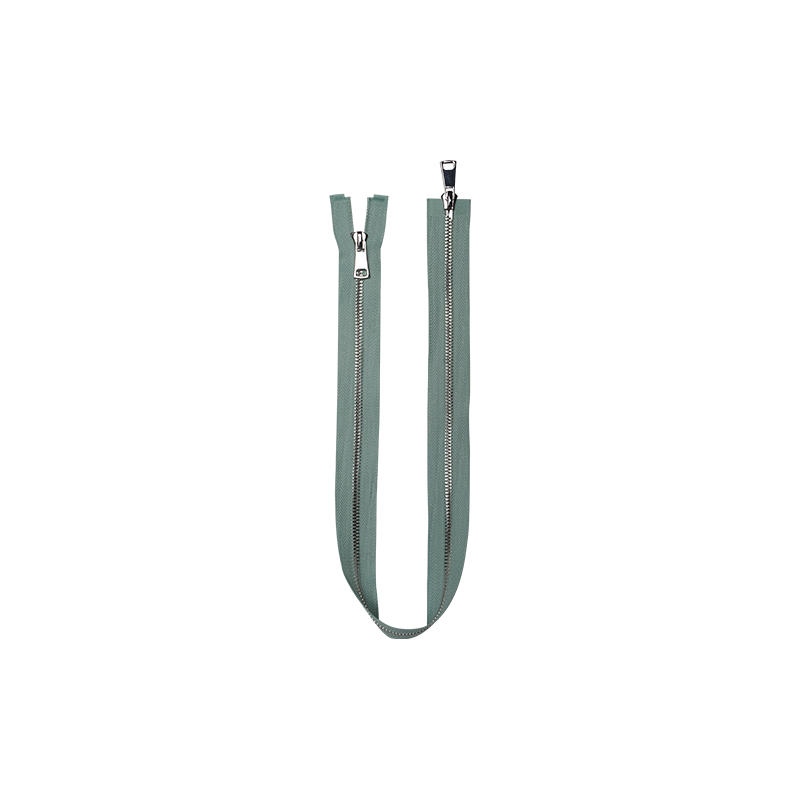
Metal zippers use individual teeth clamped or crimped onto the tape from a wire or flat stock. Brass, aluminium, and nickel alloys are the most common tooth materials, each with distinct hardness and corrosion profiles. Metal teeth have the highest dimensional mass per gauge unit, which contributes to the high tensile strength and premium hand feel that makes metal zippers the standard specification for denim, leather goods, and luxury accessories. Metal zipper chain dimensions and finishing options vary by alloy and plating specification.
Matching Dimensions to Application: A Practical Specification Guide
The table below consolidates the key dimensional parameters for the most common product categories. Use it as a starting point for specification — then confirm exact tape width, chain thickness, and length tolerance requirements with your supplier before committing to production quantities.
| Product Category | Recommended Gauge | Chain Type | Key Dimension to Verify |
|---|---|---|---|
| Fine garments, dresses, skirts | #2–#3 | Nylon coil / invisible | Tape width (narrow for concealed seams) |
| Casual jackets, sportswear | #5 | Nylon coil or Delrin | Length tolerance (±2–3 mm) |
| Bags, backpacks, luggage | #5–#8 | Nylon coil or metal | Chain thickness (layered construction) |
| Denim and leather goods | #5–#8 | Metal | Tooth alloy and finish specification |
| Outdoor gear, tents, sleeping bags | #8–#10 | Delrin | UV and corrosion resistance; tape material |
| Marine canvas, boat covers | #10–#15 | Delrin | Chain width tolerance under load cycling |
| Industrial enclosures, heavy covers | #10–#15 | Delrin or metal | Tensile strength rating (ASTM D2061) |
When submitting a specification to a supplier, the minimum information needed for an accurate quote and prototype is: gauge, chain type (nylon / Delrin / metal), tape width, active length (with tolerance), and finish or plating requirements. Omitting any one of these creates room for interpretation that may not match your design intent — and correcting dimensional errors after sampling costs significantly more than resolving them at the specification stage.
For buyers sourcing finished metal zippers for garment and accessory production, having a complete dimensional specification also simplifies cross-supplier comparison — allowing like-for-like evaluation on gauge, tape, length, and finish rather than relying on catalogue descriptions that may not align across manufacturers.
Zipper dimensions are not complicated, but they are specific. A systematic approach to all three measurement axes — gauge, tape width, and length — is the clearest path to a closure that performs exactly as intended across every unit in a production run.